
AU-700 Series: Delivering jitterless, high-reliability communication
This wireless TSN-compatible local 5G device achieves industry-leading jitterless communication with delay variation under 1μs. Compliant with 3GPP Release-16 and supporting major industrial network protocols including CC-Link IE TSN, EtherCAT, and MECHATROLINK-4, it enables complete wireless replacement of wired cables. Following the June 2025 release of the AU-700gNB/UE, a compact model AU-700gNB-W/UE-W equipped with our in-house developed MC-001 baseband semiconductor is scheduled for release in December 2025.These solutions contribute to realizing next-generation smart factories that demand microsecond-level precision synchronization for PLC control and motion control applications.
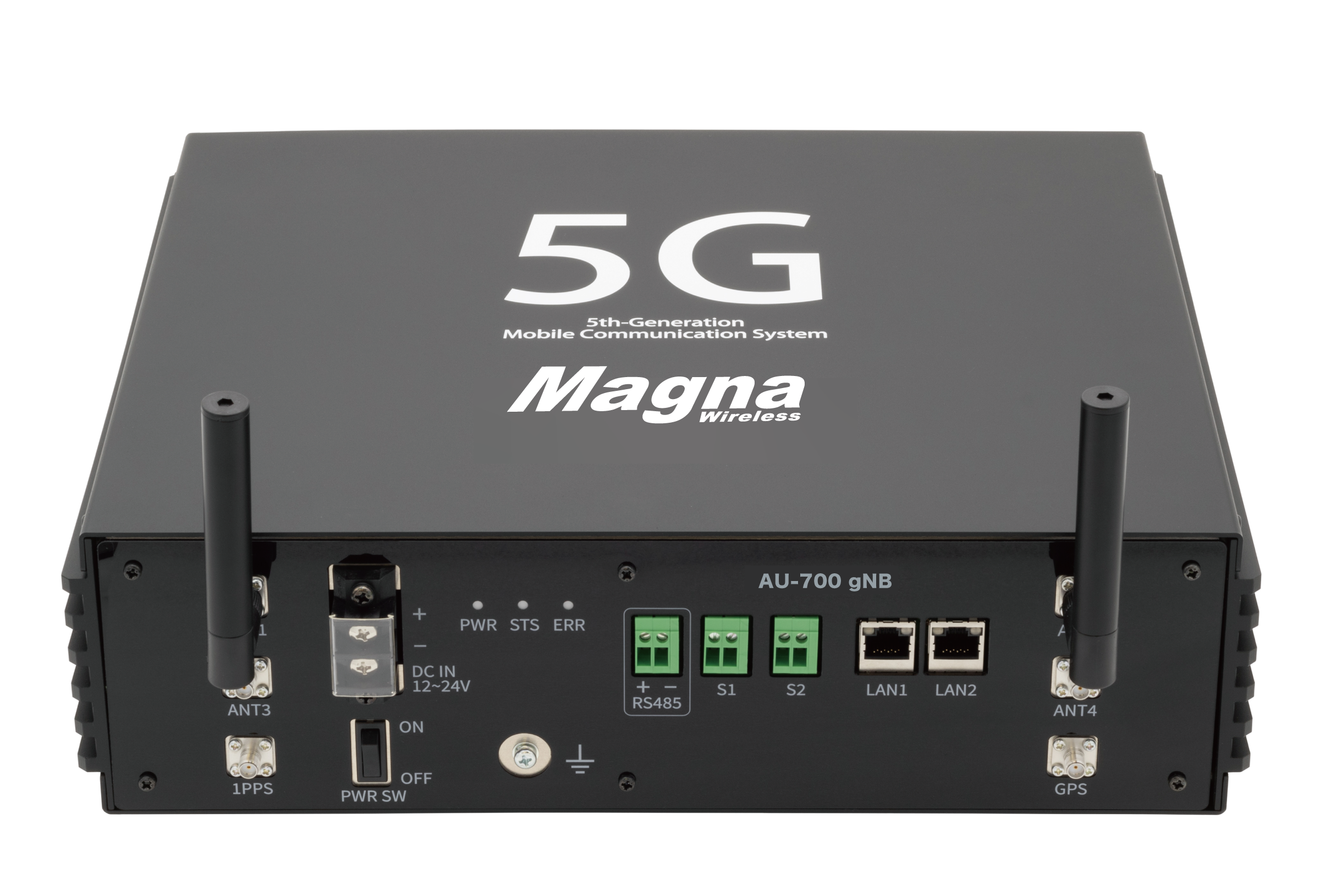
AU-700gNB
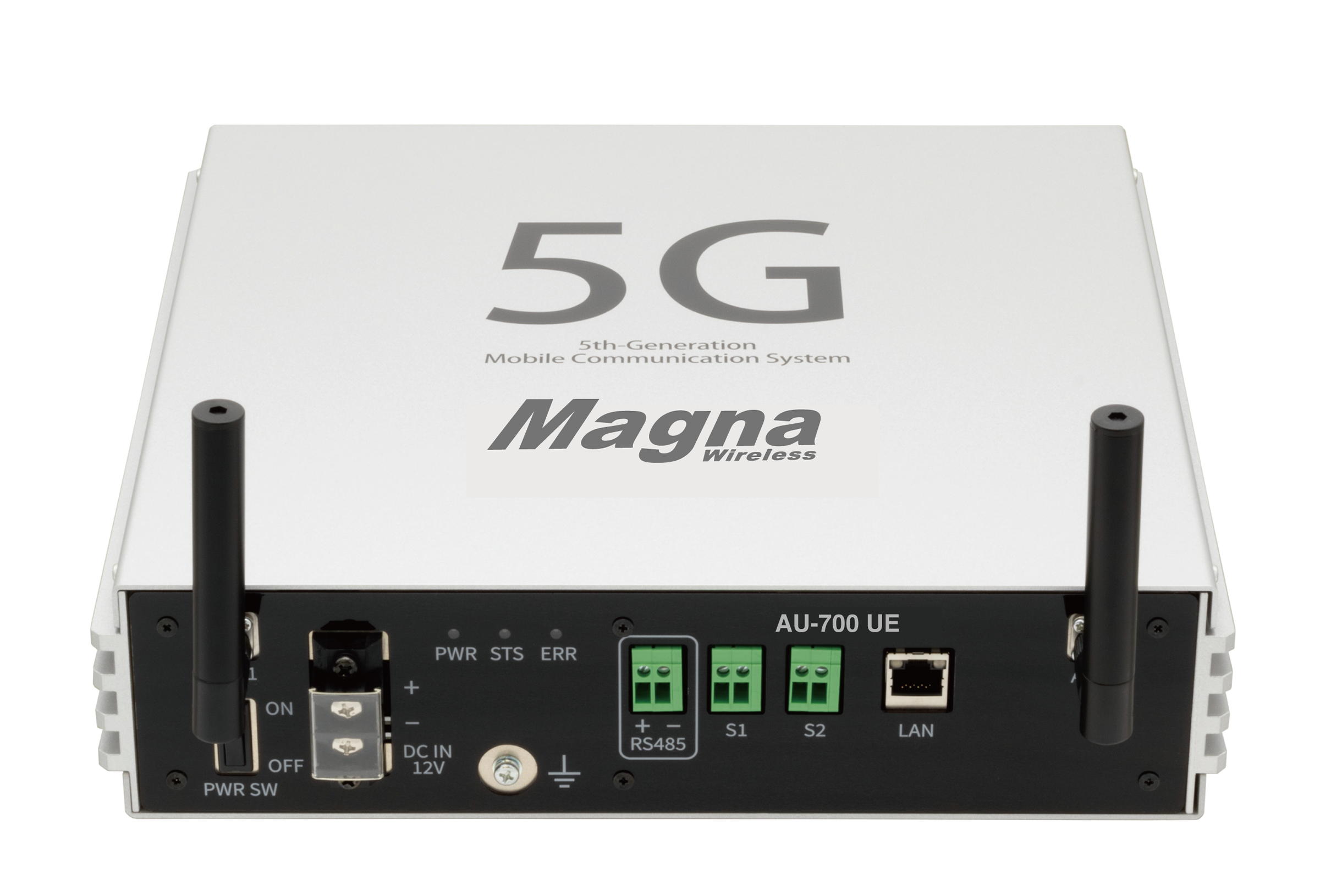
AU-700UE
Main Specifications
- Center Frequency
- 4,849.98 MHzSelectable between 4.6-4.9 GHz at time of shipment
- System Bandwidth
- 100MHz
- Maximum
Transmission Power - +23dBmgNodeB / UE
- Number of Antennas
- 2 Tx / 2 RxgNodeB (Max. 2 Tx, Max. 2 Rx)
- DL:UL Ratio
- Variable / Base
Station CompliantSemi-synchronous format, customizable - Transmit
Power Control - Supported
- Handover
- SupportedMulti-cell operation using SFN (Single Frequency Network)
- DL Maximum Throughput
- 100Mbps/gNB, 10Mbps/UEMaximum DL throughput per base station: 100 Mbps (L1 calculated value)
- UL Maximum Throughput
- 100Mbps/gNB, 10Mbps/UEMaximum DL throughput per base station: 100 Mbps (L1 calculated value)
- Occupied Bandwidth
- VariableDefault 33 MHz, Max. 100 MHz
- Latency
- 10msec typIP layer round-trip latency (ping RTT) / Low-latency customization available
- Maximum Number of
Connected Devices - 12 unitsMaximum simultaneous connections: Expandable up to 100 devices
- Time Synchronization
- SupportedGPS signal input or 1PPS signal input to base station
- Terminal Authentication
- SIMSIM card built into UE
AU-650 Series: Local 5G product with fully domestically developed technology
Developed as Japan's first domestically produced local 5G product, the AU-650 Series delivers Ultra-Reliable Low-Latency Communication (URLLC) for mission-critical real-time control applications. Comprising the AU-650gNB all-in-one compact base station and AU-650UE CPE-type mobile station, it achieves round-trip latency under 10ms and maximum system throughput of 300Mbps. Supporting simultaneous connections for multiple terminals with integrated RU/DU/CU/5GC functions in the base station, it enables simple local 5G system deployment. Having earned high praise in various field trials for smart factory applications including AGV control, industrial robotics, and machine tools, this product has become a cornerstone for local 5G adoption.

AU-650gNB

AU-650UE
Main Specifications
- Target Applications
- FA / High-reliability, low-latency systemsApplications including image/video signal data transmission and low-latency feedback control systems
- Frequency Band /
Bandwidth - 5GNR / 4.8GHz/ 100MHzCompliant with semi-synchronous system parameters
- Maximum Throughput
(System) - DL/UL:300MbpsTerminal throughput: 100 Mbps
- Round-trip Latency
- 10msec typWhen connected to our terminals
- Handover / CA / MIMO
- Handover: Supported / CA: Not supported / 2×2 MIMO: SupportedSequential release
- Terminal Authentication
- SIM-based authenticationTerminals provided with pre-installed SIM
- Architecture
- All-in-oneIntegrated RU/DU/CU/5G Core
- 3GPP Version
- Releas-15/16Release updates, system maintenance, and optional features require separate purchase
Why Magna Wireless?
Built on our proprietary hardware and software IP, along with our core baseband IC devices, we not only comply with 3GPP standard specifications but also offer flexible customization for 6G validation functions. Furthermore, our fully domestic software and hardware development ensures a stable domestic supply chain and long-term support structure.
From local 5G to next-generation local 6G, we provide a reliable wireless communication platform you can trust. As wireless communication specialists, we are committed to supporting the future with technology, meeting the growing needs for labor-saving and unmanned operations driven by Japan's aging population and declining birthrate.